To receive a free PDF copy of The Fundamentals of Electrocardiograph Interpretation by Harry Mond, subscribe to his email blog by entering your email address below.
Thank you! Your submission has been received!
Oops! Something went wrong while submitting the form.
Purchase the textbook
Purchase a hard cover or paperback copy of The Fundamentals of Electrocardiograph Interpretation by Harry Mond on Amazon.
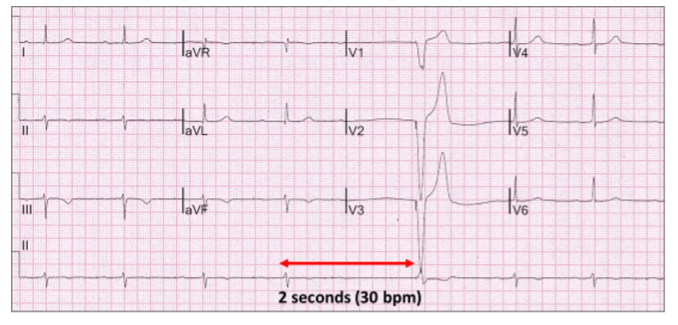
32-year old with an implanted Medtronic dual chamber pacemaker for sick sinus syndrome. ECG reported as malfunction with a ventricular escape rate of 30 bpm. All bradycardia pacemakers have a programmable low rate of 30 bpm.
Rhythm strips: Look carefully
What do you think?
Sick sinus syndrome usually means atrial pacing so look for it!
Bipolar atrial pacing (Ap, red arrows), rate 50 bpm with Wenckebach AV block (red highlight)and a dropped beat (yellow highlight).
But we saw ventricular pacing at 30 bpm.
Following the atrial pacing and dropped beat, there is both atrial and ventricular pacing with an 80 msec delay. Then follows atrial pacing with a long AV delay.
This is not pacemaker malfunction, but rather inappropriate use of a very successful ventricular pacing minimization algorithm manufactured by Medtronic ( Minneapolis MN, USA) called Managed Ventricular Pacing (MVPTM).To preventleft ventricular dysfunction, such algorithms are designed to avoid ventricular pacing in patients when it is not necessary.The pacemaker effectively paces AAI(R), but in the event of failed AV conduction, will mode convert to dual chamber-ventricular pacing. I call this algorithm-offset.
With MVP, failure of AV conduction during AAI(R) pacing requires a specific number of events before conversion to DDD(R) pacing. If failure of AV conduction occurs for one cycle, then the next atrial paced event is followed by ventricular pacing with a very short 80 ms AV delay.
Wenckebach AV block. Atrial pacing (Ap) with ventricular sensing (Vs) and a dropped atrial paced beat (red highlight). The next Ap Vp has an 80 ms delay (yellow highlight). There is mode conversion for one cycle, but no algorithm-offset.
Algorithm-offset to DDD(R) pacing will occur if two of four consecutive cycles have failure of AV conduction (red highlight and numbers 1 and 4).
Two short 80 ms AV delays (yellow highlight) followed by AP VP with the programmed AV delay (blue highlight) after a ventricular ectopic.
Never diagnose single chamber ventricular pacing until you have excluded atrial pacing, which can be very subtle.
Unusual pacing ECGs are frequently due to algorithms.
Retrograde conduction is defined as conduction from an ectopic site to the atrium via the AV node or accessory pathway and referred to as VA conduction. II results in a P wave configuration which differs from an anterograde P wave, and in most ECG leads is inverted. The site from where the impulse originates can be the AV node, Bundle of His, distal conducting system or the body of the ventricles including ventricular pacing. On the ECG, the QRS complex usually precedes the inverted retrograde P wave but on occasion may follow it.
In 1970, I commenced work as a “novice” cardiologist at The Royal Melbourne Hospital. Training at that time was learning how to recognise the diastolic murmur of mitral stenosis and making sure the ECG and chest x-rays were the correct way up. As this was prior to coronary artery surgery, stenting and echocardiography, the ECG was a highly respected tool for the diagnosis of many conditions. I was fortunate to befriend a number of the gurus of ECG interpretation who taught me to look into the soul of an ECG. Today, even though the ECG is the first investigation performed by a cardiologist, the art of ECG interpretation has been lost because we depend on the new tools for cardiac diagnosis.
Dr Thura Thant asked for an opinion on this confusing ECG. By using arrows and highlight, the ECG bared its soul and gave me an answer. See if you can work it out? What do you think?