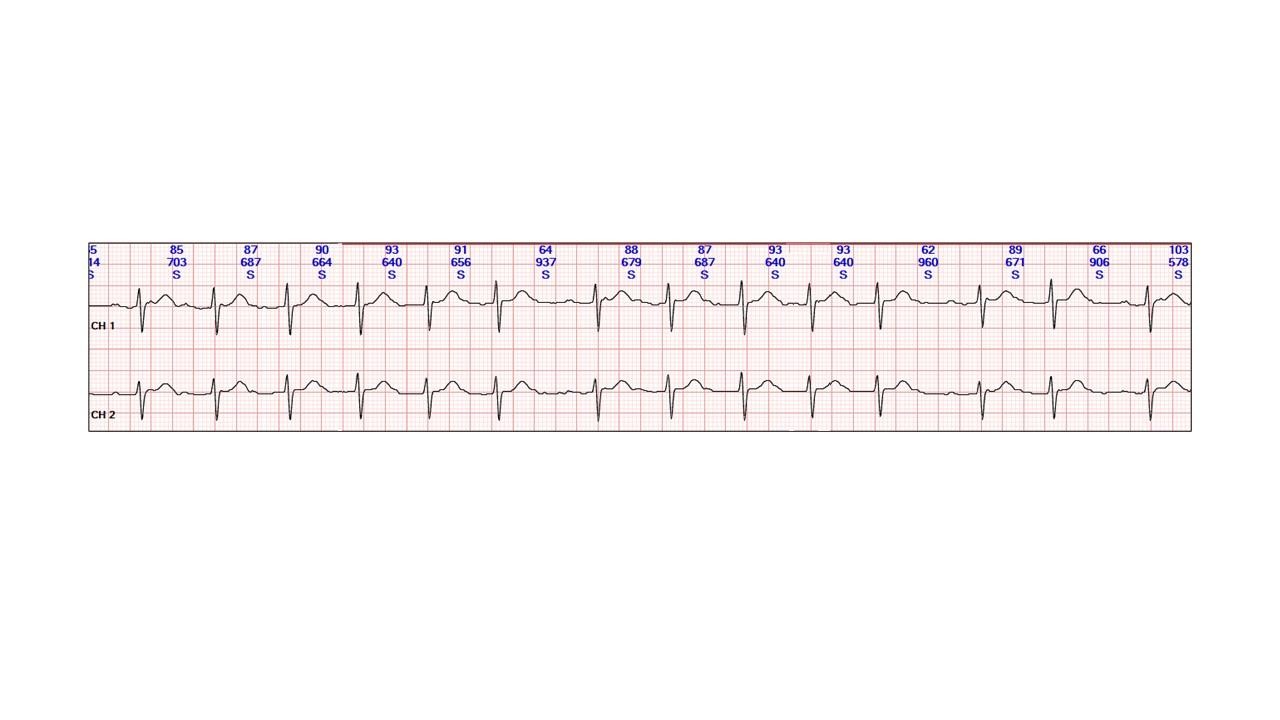
I was asked to review this Holter monitor, the report of which stated:
“Sinus rhythm, ventricular rate ~ 90 bpm, Wenckebach AV block”.
What do you think?
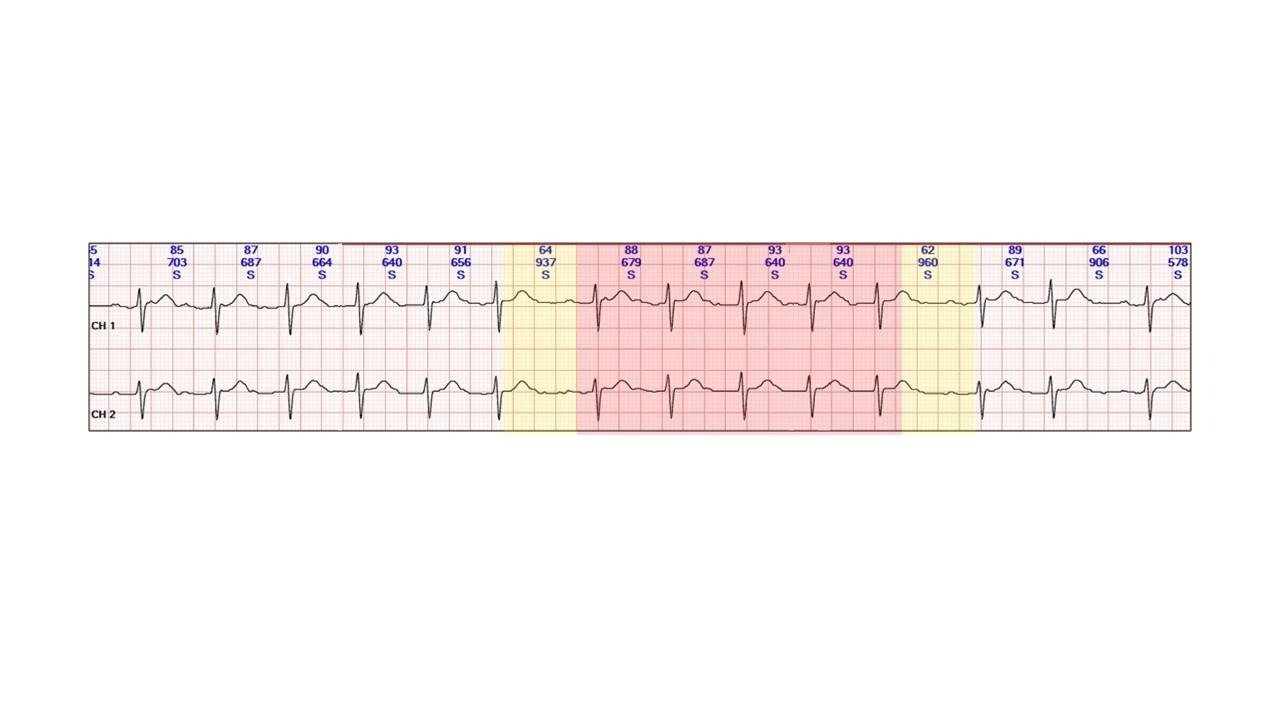
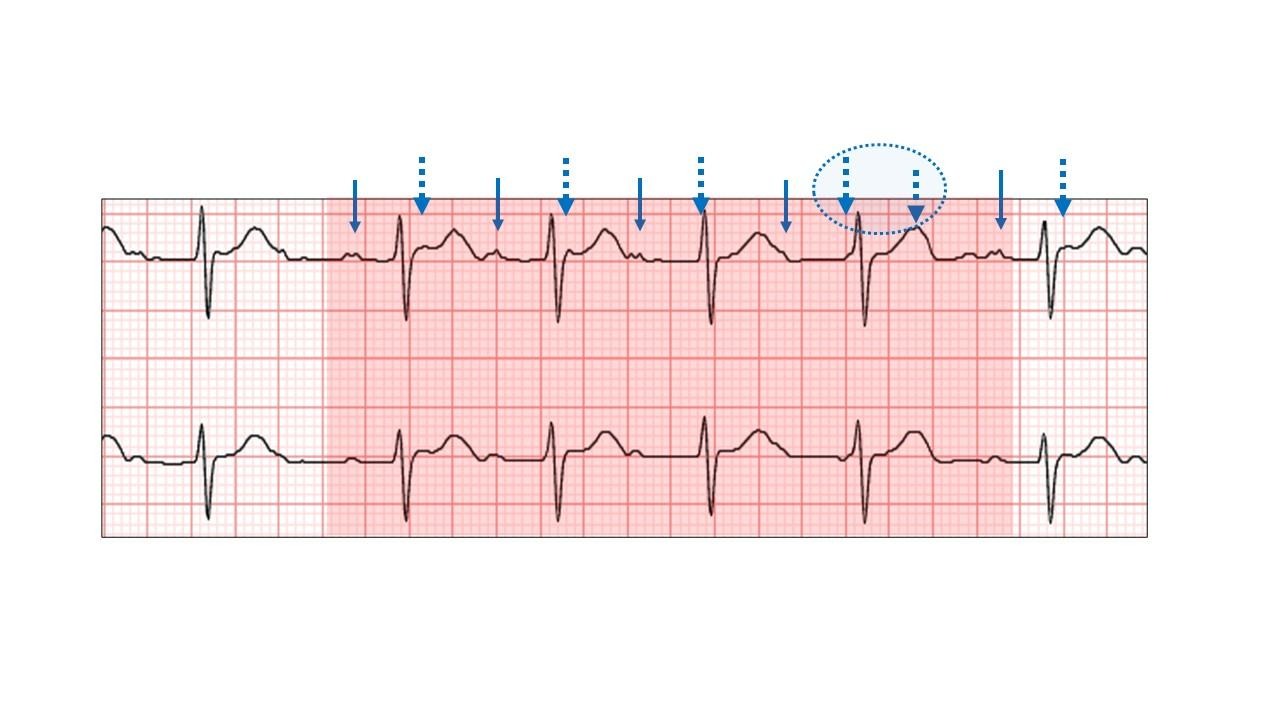
The tracing supports Wenckebach AV block. There are sequences (red highlight) separated by short pauses containing a P wave,
Let us review these sequences more carefully.
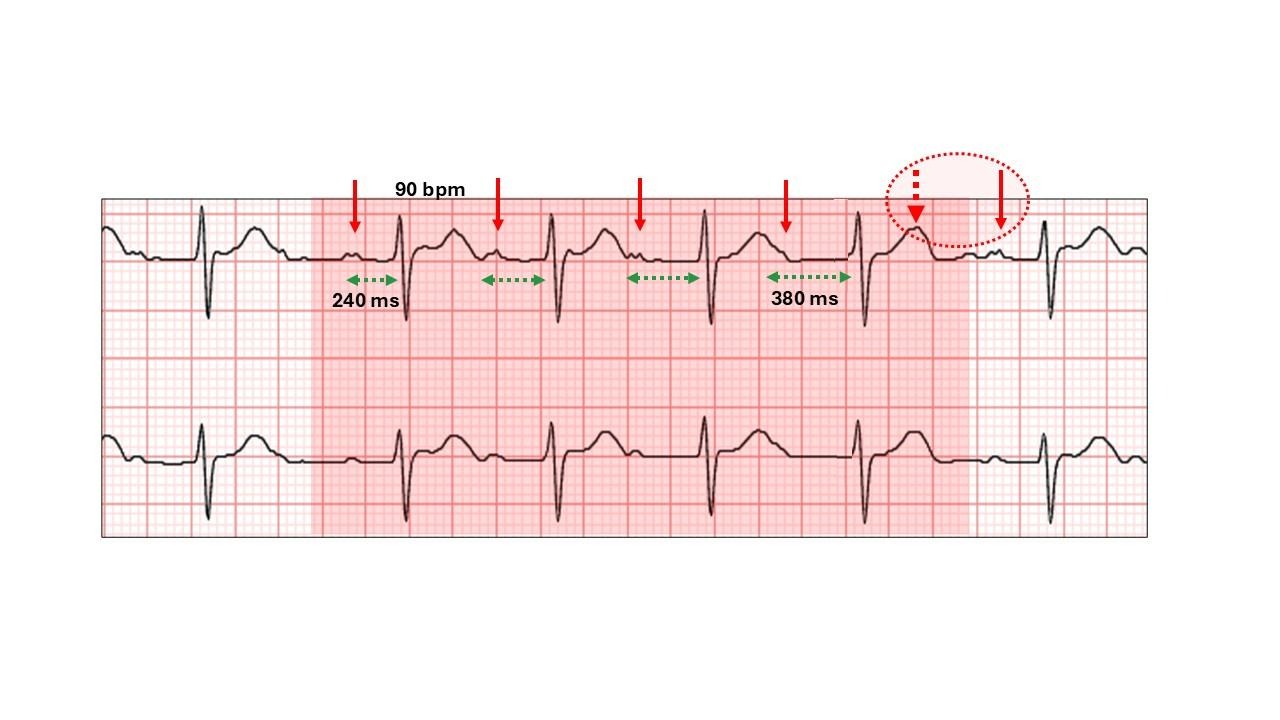
The footprints of Wenckebach AV block have been fulfilled:
Atrial rate 90 bpm.
Progressive increase in PR interval from 240 to 380 ms (green stippled arrows).
Dropped beat (heavy red stippled arrow).
The next sequence commences with the shortest PR interval.
The next sequence, however, commences much earlier with a short P-P interval (red stippled oval).
How do we explain this?
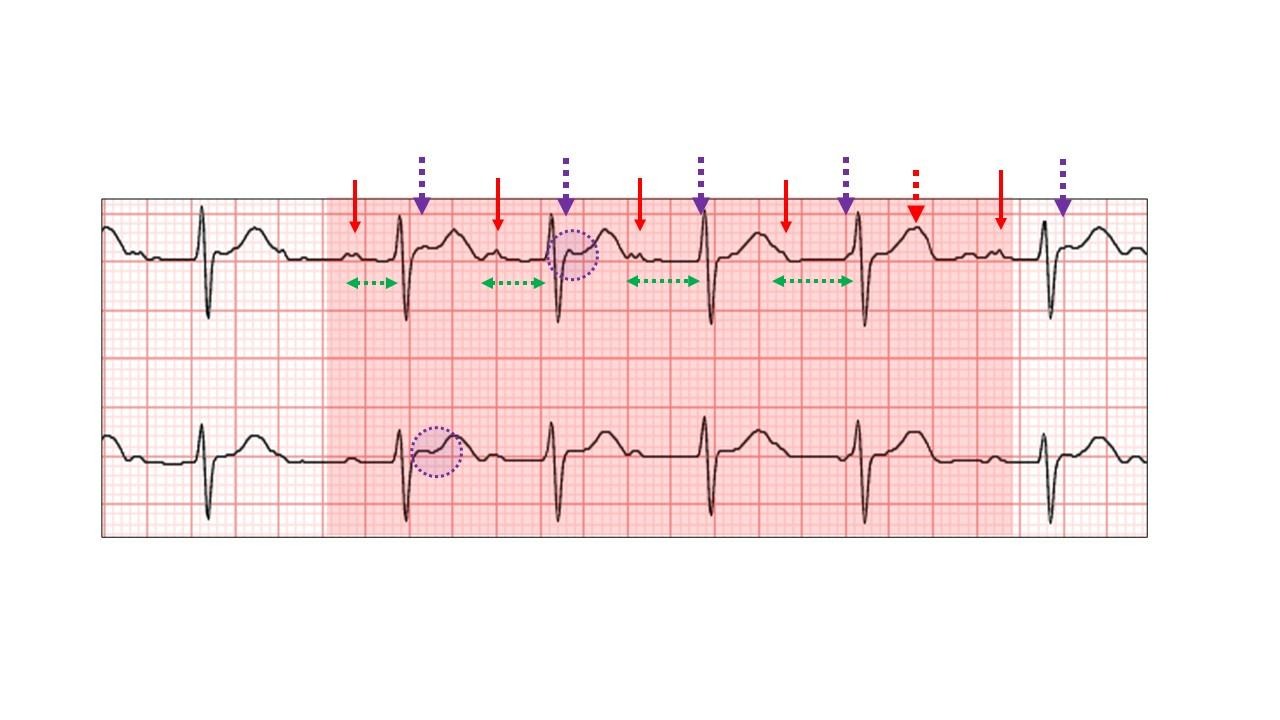
Between each P wave, there are non-conducting partially or completely concealed” P waves (purple stippled arrows), which distort the ST segment (purple circles).
The rhythm is not sinus but atrial tachycardia, 190 bpm (blue arrows).
The sequence ends with two non-conducted P waves (blue oval), one related to Wenckebach AV block and the other to alternating non-conducting P waves. A new sequence commences with a conducting P wave rather than a non-conducted P wave.
The diagnosis is:
Atrial tachycardia (190 bpm) with 5:4 alternating Wenckebach AV block and a ventricular response of ~ 90 bpm.
Tell me about alternating Wenckebach AV block.
The AV junction, with its decremental conduction, plays a vital role in controlling the propagating wave of depolarization on its passage to the ventricle. Not only is the traffic slowed but under certain circumstances partial or complete blocks occur as can be seen with Wenckebach AV block. What is poorly understood is that more than one block can occur in series. This can be both physiologically with rapid atrial rhythms and pathologically with conduction system disease. When two blocks occur in series, it is called alternating Wenckebach AV block and because they occur at different levels, they are multilevel blocks.
Particularly with rapid atrial rhythms, alternating Wenckebach AV block is often difficult to visualize on the surface ECG and therefore the tracings are best described when associated with a bradyarrhythmia resultant from advanced degenerative changes in the AV junction. The tracings are usually mistaken for complete AV block with the difference being the presence of an irregular ventricular rate but with regular Wenckebach sequences.
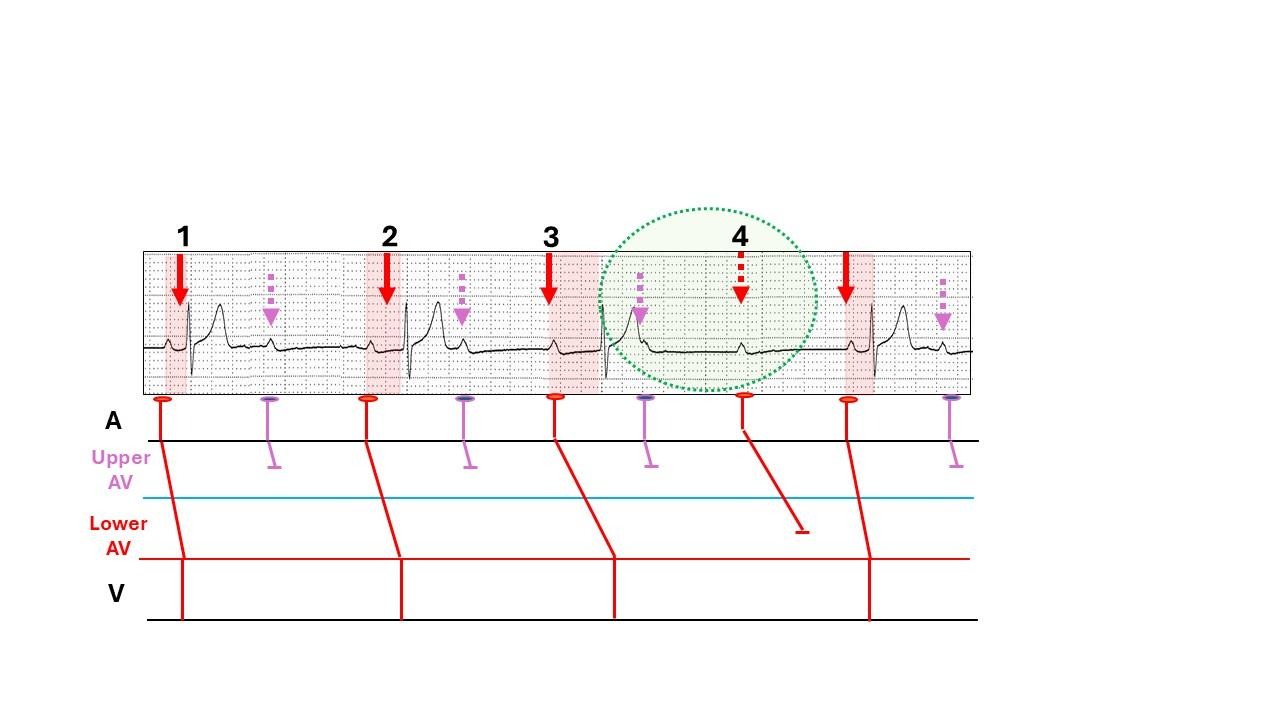
Sinus rhythm (arrows) with two blocks; one high (purple) and the other low (red), with the combination, a multilevel block.
With pathology in the AV junction the propagating wave of depolarization encounters two blocks. For a simplistic explanation, the conducting impulse is first subjected to 2:1 AV block (pink), probably within the AV node.
The alternating conducted impulses then encounter 4:3 Wenckebach (red) either in the AV node or more distal conducting system.
A new sequence commences without an intervening 2:1 blocked beat.
With a slow sinus rate, only two consecutive non-conducted sinus P waves occur (green stippled open oval).
Remember this is serious pathology and can occur with a bundle branch block, syncope, and sudden death.
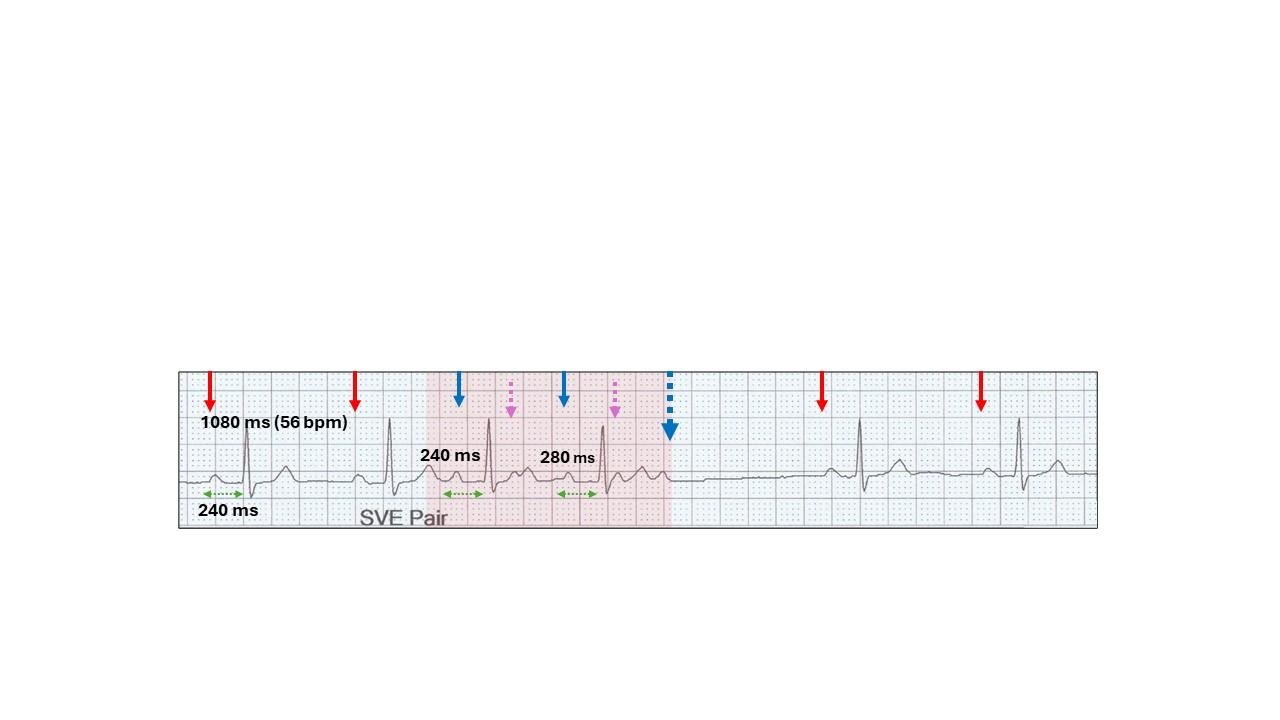
With atrial tachyarrhythmias, alternating Wenckebach AV block can also be seen as protecting the ventricles from rapid atrial rates and thus physiological in the presence of atrial pathology. The arrhythmia is best identified when the P waves are discrete as in this very short run of atrial tachycardia, diagnosed as an atrial couplet (SVE pair).
Sinus rhythm (red arrows), rate 56 bpm.
Five beat run of rapid atrial tachycardia (188 bpm) with two conducted P waves (blue arrows) demonstrating 3:2 Wenckebach AV block and a dropped beat (large stippled blue arrow).
There are alternating non-conducted P waves (stippled pink arrows) and the run is terminated by two consecutive non-conducted P waves.
The ventricular rate is controlled.
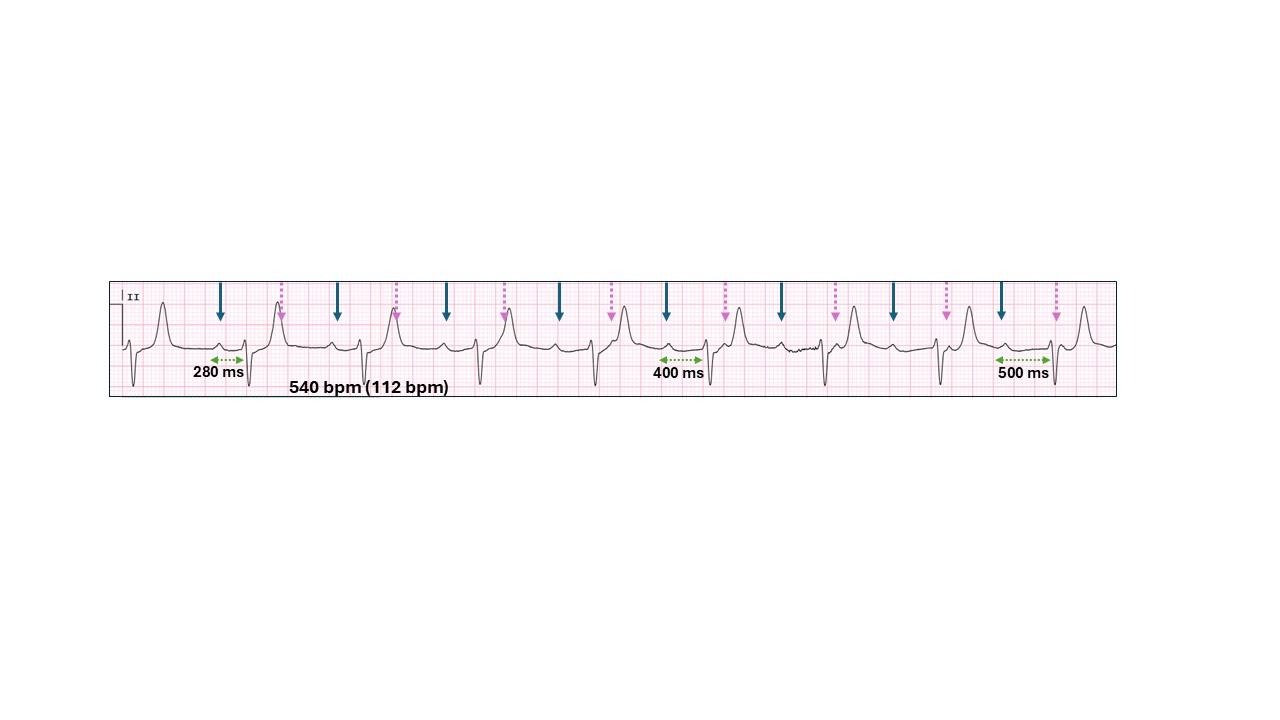
When the rate of the atrial tachyarrhythmia is relatively slow, the alternating 2:1 AV block may be sufficient to control the ventricular response, so that the Wenckebach sequences may be very long and without dropped beats.
Slow atrial tachycardia (112 bpm) with alternating Wenckebach AV block. There is 2:1 AV block (purple stippled arrows) and alternating conducted beats (blue arrows) with a gradual increase in the PR interval and no dropped beats. The ventricular response is slow and near regular.
Most cases of alternating Wenckebach AV block occur with atrial flutter or a macro-reentrant atrial tachycardia but are hard to diagnose because of poorly visualized P waves on the ECG. Like conventional Wenckebach AV block, there are sequences.
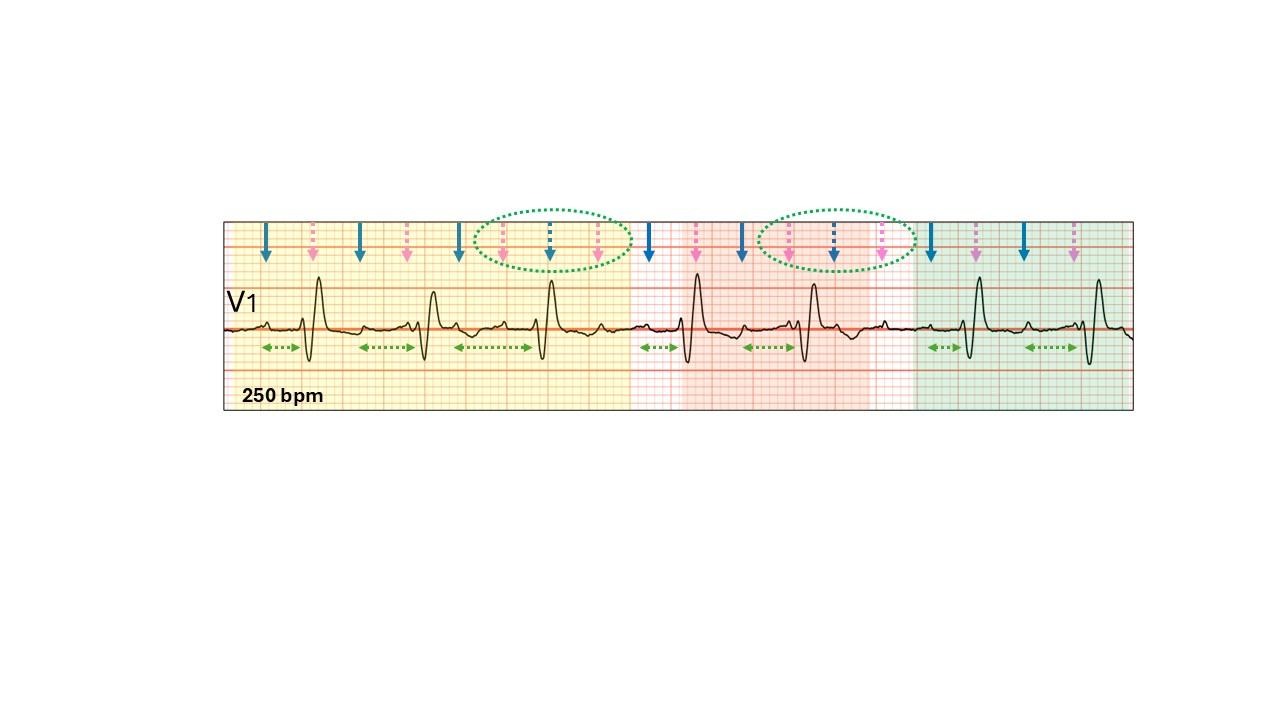
Atrial flutter rate 250 bpm with a controlled ventricular response. There are three sequences. The first (yellow highlight) is 4:3 Wenckebach AV block (blue arrows) alternating with non-conducted flutter waves (pink stippled arrows) and because of the rapid atrial rate, There are three consecutive dropped P waves (green open stippled oval). There are two more sequences (orange and green highlight). Note the conducted P wave is not necessarily the closest to the QRS.
This is how we usually see alternating Wenckebach AV block with atrial flutter.
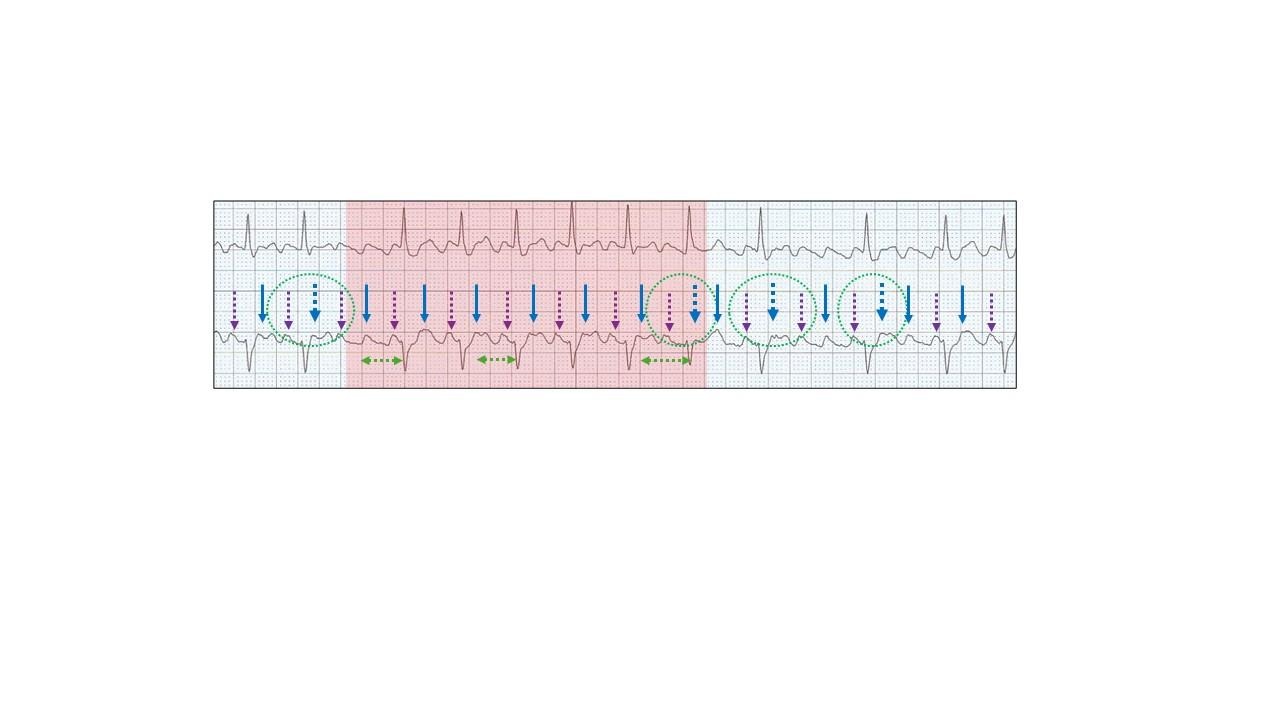
Atrial flutter (arrows), rate 250 bpm with a sequences of six ventricular responses (red highlight), each with an increasing PR interval (green stippled arrows) until a dropped beat (wide blue stippled arrow). There are alternate non-conducting P waves (purple stippled arrows), and the sequence is terminated by two dropped beats (green stippled open ovals). Other sequences have three dropped beats associated with a short pause.
We think AI is amazing but the rate control of alternating Wenckebach AV block is even better. Next time you see atrial flutter with sequences, look into the soul of the rhythm. There is magic hidden there.
Harry Mond
Download a free PDF copy!
To receive a free PDF copy of The Fundamentals of Electrocardiograph Interpretation by Harry Mond, subscribe to his email blog by entering your email address below.
Thank you! Your submission has been received!
Oops! Something went wrong while submitting the form.
Purchase the textbook
Purchase a hard cover or paperback copy of The Fundamentals of Electrocardiograph Interpretation by Harry Mond on Amazon.
Fusion is another lesson in timing! Fusion beats are an amalgam of two competing rhythms. Both are responsible for partial depolarization of the respective chambers and depending on the contribution of each, result in progeny with similarities to one or both parents.